Magnum Push Piers
Steel push piers down to deep bearing ground, each tested.

Causes of subsidence
A foundation rarely subsides for no reason. Usually something changes in the ground underneath. Knowing the cause means choosing the right solution and keeping the problem from coming back.
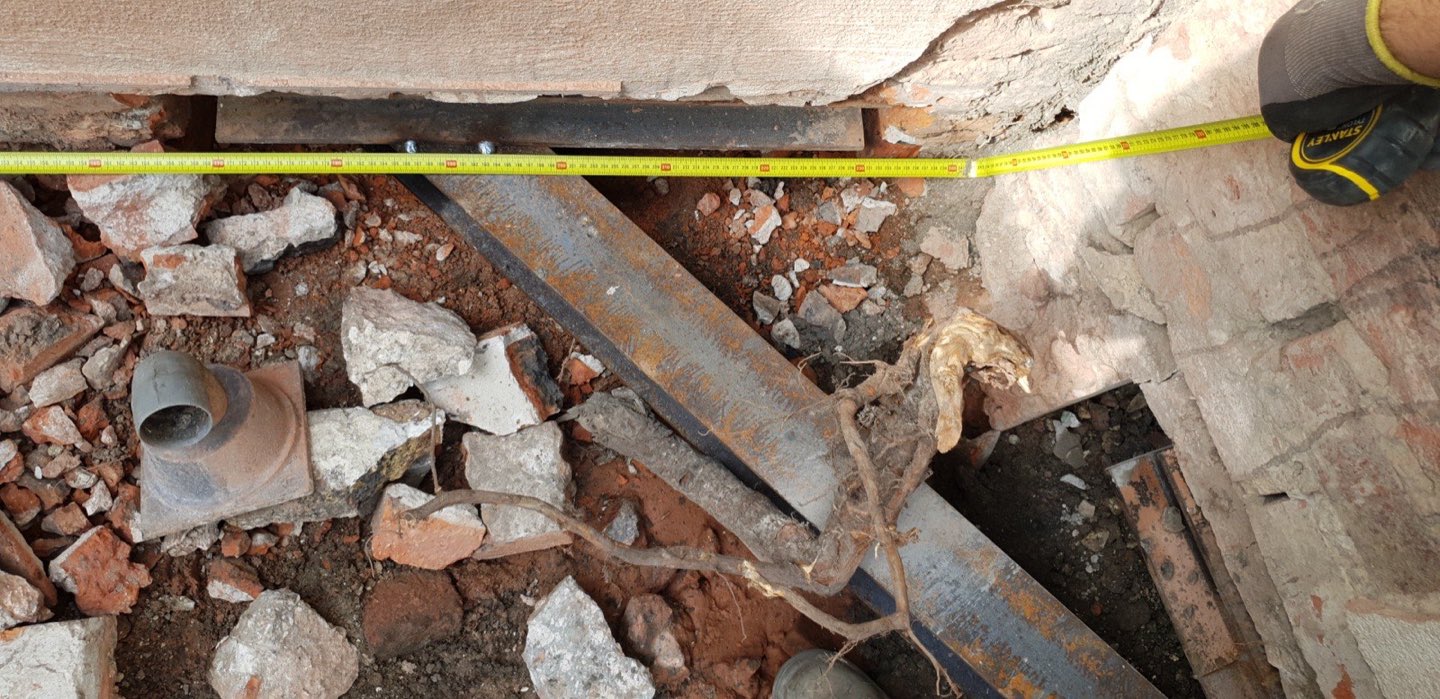
Clay shrinks as it dries and swells when it gets wet again. In a normal year the seasons affect the ground to about 1.5 m deep. Houses with foundations at 60 to 80 cm sit in the zone that moves. The highest risk is in the old, highly plastic clays such as Boom Clay and Ypres Clay.
A leak wets the ground locally and can wash soil away. Have the drains checked by camera before repairing: otherwise the problem comes back.
On a hot day a large tree draws up to about 500 litres of water from the ground, on clay up to 1 to 1.5 times its height away and down to 5 m deep. Buildwise recommends a distance of at least 1 times the tree height.
Excavation, dewatering or pile driving next to your home can make the ground under your foundation move. Have the condition of your home recorded before nearby works start.
Peat, made ground or poorly compacted soil can keep settling under load. With floors it shows as voids and slabs out of level.
With serious damage, have a structural engineer assess the situation. Soiltek is a specialist contractor: we record, measure, propose a technique and carry out the repair, in consultation with your engineer.
Steel push piers down to deep bearing ground, each tested.
Expanding resin strengthens the ground under the foundation, without digging.
Sunken concrete floors back to level.
First the cause, then the right technique.
Much of Flanders and Wallonia has clay that shrinks in drought. After dry summers we see more cracks. Leaking drains and trees often play a part too.
Have the drains checked by camera, keep trees and large shrubs away from the façade and monitor cracks with a crack gauge.
In Flanders you can check the DOV database (theme: plastic soils), in Wallonia Geoportail. A CPT sounding on site gives certainty.
Send us a few photos of the cracks and the surroundings of your house. We will look, with no obligation, at what may be going on.
Report your cracksRead also: Cracks in walls · Subsiding house · Buying a house with cracks · Cracks after a dry summer · Trees next to your house on clay · Cracks from shrinking clay: from survey to repair