
Drought and clay series · October 2026
Cracks from shrinking clay: from investigation to repair
Do you see cracks that widen after a dry spell? A proper investigation is the first step. Only then do you choose the right repair.
Investigate first
Buildwise describes a fixed sequence. First a desk study: maps and the DOV database to know the soil, and old aerial photos to see whether there used to be trees or buildings. Then a site investigation: usually at least three CPT soundings and two boreholes to 3 m (5 m if trees may play a role), with water content measured every half metre and the plasticity index at foundation level.
Measure instead of guess
- Level survey of a mortar joint: the level of one continuous joint is surveyed all around the house, showing exactly where and how much it has settled.
- Floor survey: the level of the floors on a grid of, for example, 2 × 2 m.
- Crack gauges: the width of the cracks is recorded and monitored.
Repeat those measurements, for example every three months. That shows whether the movement stops or continues, and whether it follows the seasons.
Which repairs exist?
Tackle the cause. Repair a leaking sewer, prune trees or install a root barrier (see our article on trees). For damage from seasonal changes, a watertight strip at least 1.5 m wide around the house, sloping 2% away from the façade, can keep the ground under the foundation more stable. It must then run around the whole house.
Deepen the foundation. If the ground keeps moving, the load is transferred to a deeper, stable layer below the zone that dries out. Traditional techniques are underpinning in masonry or in trenches (limited in depth), micropiles and jet grouting.
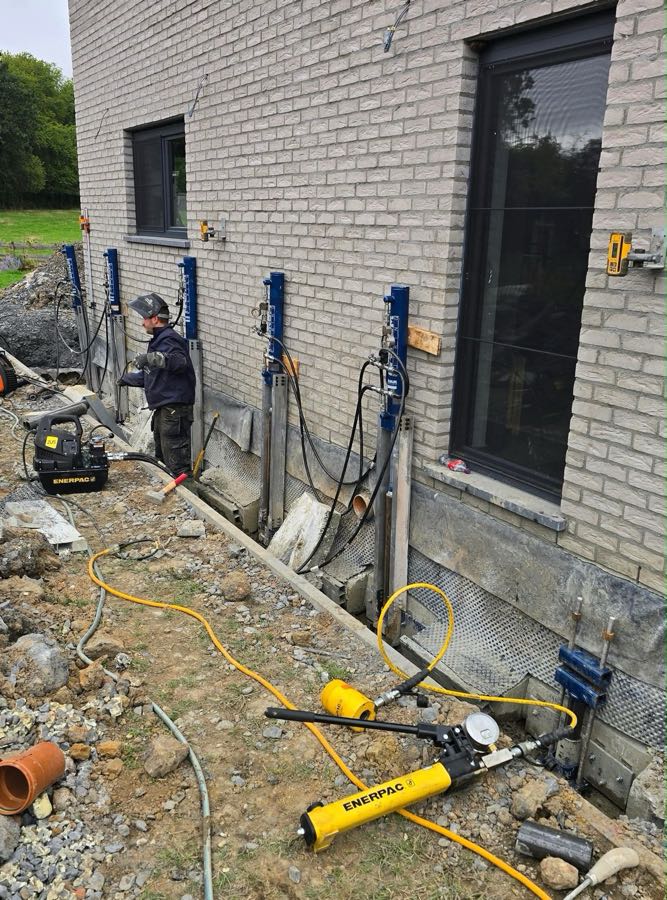
For this Soiltek uses Magnum Push Piers: steel tubes we push hydraulically under the existing foundation, with the weight of the house as reaction, down to a load-bearing layer. They reach well below the drought zone of 1.5 to 3 m, every pier is tested individually and no excavator is needed. In Erquelinnes we installed nine piers this way to almost 16 m deep.
About resin. Expanding resin (our Deep Lift) fills voids and compacts the ground under a foundation. Buildwise notes that there is still little scientific literature on injections in plastic clay. For houses on shrinking clay we therefore usually combine resin with push piers, or use it where voids or loose ground are the cause.
Who does what?
With serious damage, have a structural engineer or engineering firm assess the situation. Soiltek is a specialist contractor: we record what we see on site, measure cracks and levels, propose a technique and carry out the repair, in consultation with your engineer. Read more about our subsidence survey.
Sources: Buildwise (Belgian Building Research Institute), Cracking in buildings due to shrinking or swelling of plastic soils, WTCB-Dossiers 2021/5.10 and WTCB-Contact 2018/3; M. De Vos, Special problems when building on Tertiary clay, TI-KVIV study day 2004; BRE Digests 240–242, 298 and 412. This article summarises those sources in our own words and does not replace advice from an engineer.