Screw piles
All pile types and their advantages.

Knowledge · Wind
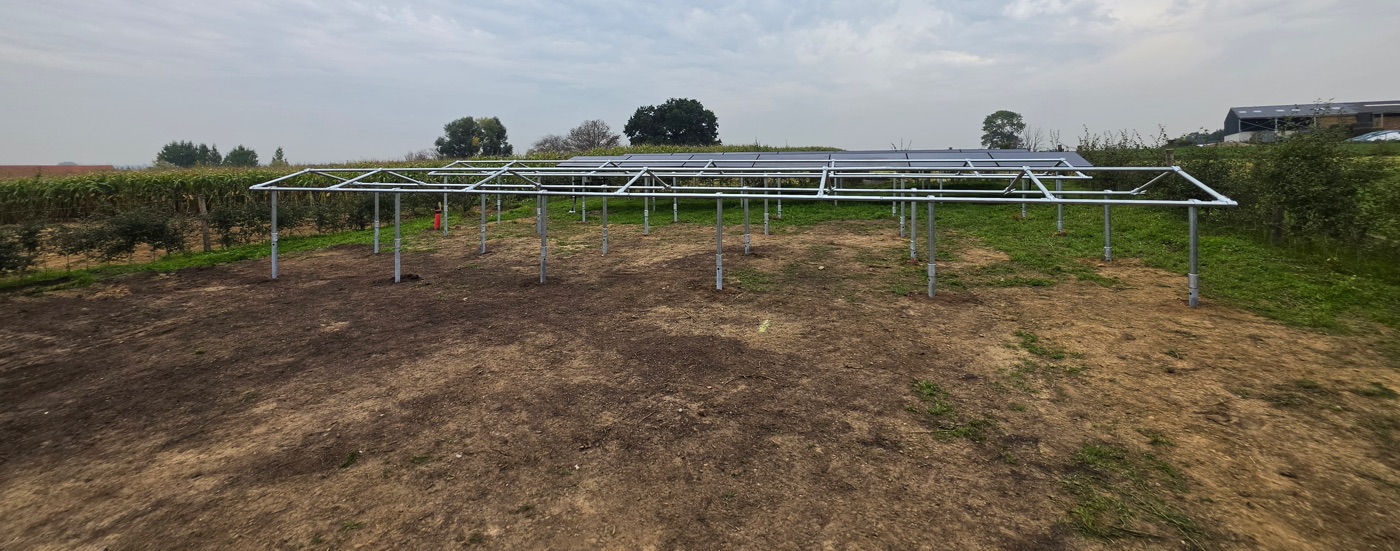
With a house, the weight pushes down. With a carport, solar panels, a pergola or a sign, the wind is often the biggest force: it tries to lift or push over the structure. The foundation then mainly has to hold down.
In tension the helix is pulled upwards. The soil above holds it down, like an anchor. So the top helix has to be deep enough: for tension piles at least 5 helix diameters. Any shallower and the soil breaks out in a cone up to the surface.
Manufacturers use a larger safety margin in tension than in compression. The Finnish method of our manufacturer Paalupiste, for example, uses an overall factor of 2.2 in compression and 2.5 to 3.0 in tension.
With a ground screw with a continuous thread, the friction along the whole screw holds it. For signs, lighting and noise barriers, where the wind pushes sideways, we use winged piles or a concrete block around the pile head: they spread the force over a larger volume of soil.
Soiltek is a specialist contractor, not an engineering firm. We provide the manufacturer's product data and align the pile proposal with your structural engineer.
Sources: H.A. Perko, Helical Piles, Wiley, 2009; NBN EN 1997-1; NBN EN 1991-1-4; Paalupiste.
All pile types and their advantages.
For light and medium structures.
How many piles do you need?
All topics in one place.
Because the wind load depends strongly on location, height and shape. For carports and canopies we take it into account in the quote.
A block has to be heavy enough not to lift. A screw pile gets its resistance from the soil above the helix and stays light and removable.
The top helix must be at least 5 times its diameter deep. The exact length depends on the soil and the force.
Send us the dimensions or a plan. We reply within two working days.
Request a quoteRead also: Installation torque and capacity: how you know a screw pile will hold · Building by and on the water · Installing ground screws yourself: how to go about it