Screw piles
All pile types and their advantages.

Knowledge · Soil
Every soil behaves differently under load. Knowing what lies under your plot means choosing the right foundation and the right depth. An overview of the soils we meet most often in Belgium.
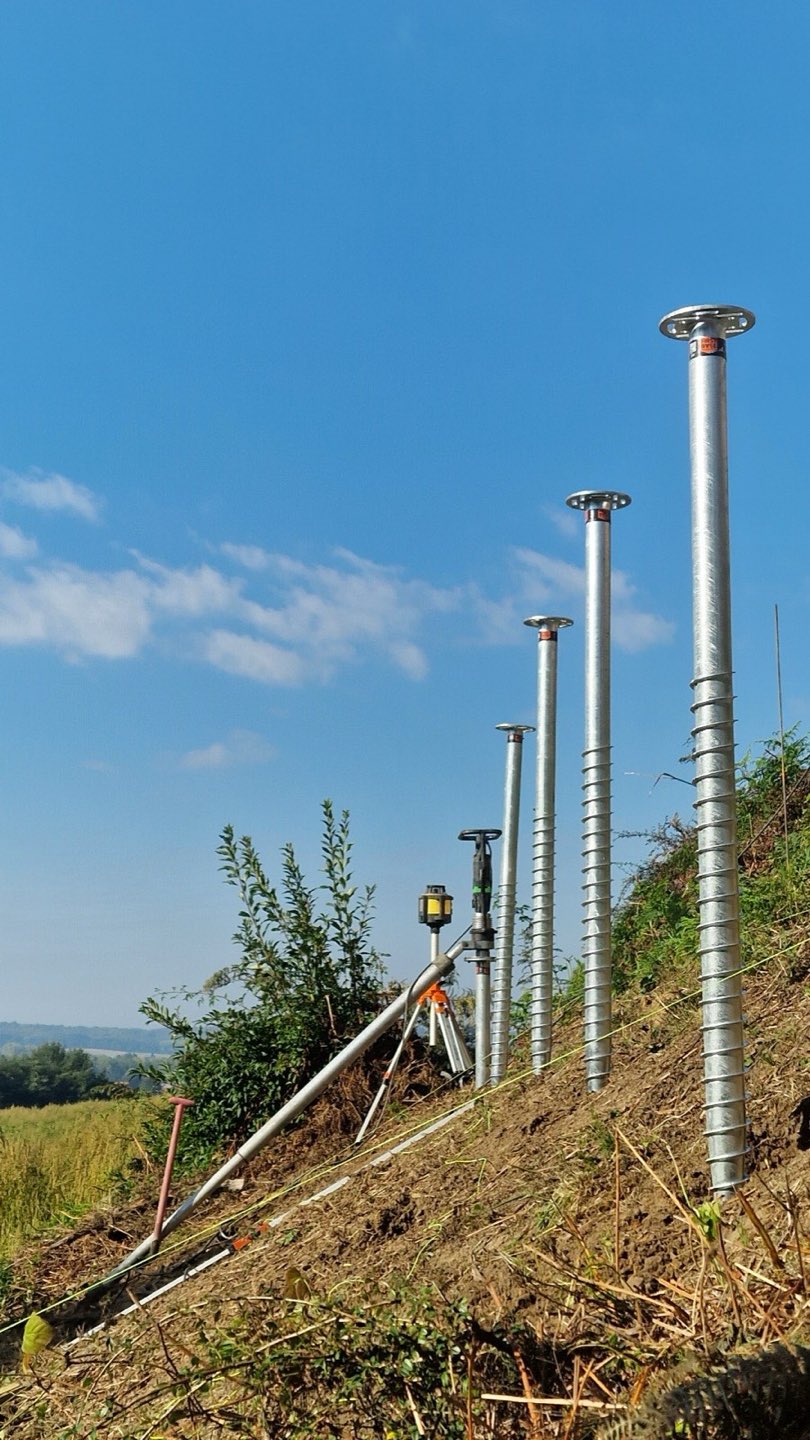
Clay carries well when it is stiff, but shrinks in drought and swells when wet. The old, highly plastic clays such as Boom Clay and Ypres Clay move with the seasons down to about 1.5 m. That is why we screw below that zone in clay.
Dense sand is often a good bearing layer: it does not shrink and carries a lot. Loose sand can still compact under vibrations or water. A helical pile in dense sand gives a high capacity.
Loam sits between sand and clay. It carries reasonably, but turns soft when wet and is sensitive to frost.
Peat is very compressible and can keep settling for years. Made ground and backfill are often poorly compacted. We go through them with screw piles down to a bearing layer, with extensions if needed.
Soiltek is a specialist contractor, not an engineering firm. We provide the manufacturer's product data and align the pile proposal with your structural engineer.
All pile types and their advantages.
For light and medium structures.
How many piles do you need?
All topics in one place.
Yes, but below the zone that moves with the seasons. With screw piles we go below that zone or down to a bearing layer.
Then we screw through it down to the bearing layer underneath, with extensions if needed. A CPT shows how thick the peat is.
Yes. Dense sand is often an excellent layer for the helix.
Send us the dimensions or a plan. We reply within two working days.
Request a quoteRead also: A CPT sounding explained: how to read the ground · Frost and foundation depth: how deep must a foundation go? · Installation torque and capacity: how you know a screw pile will hold