Screw piles
All pile types and their advantages.

Knowledge · Depth
Water in the ground expands when it freezes. If a foundation is too shallow, frost can push it up and it drops again when it thaws. That is why a foundation for structures that must not move goes below frost depth.
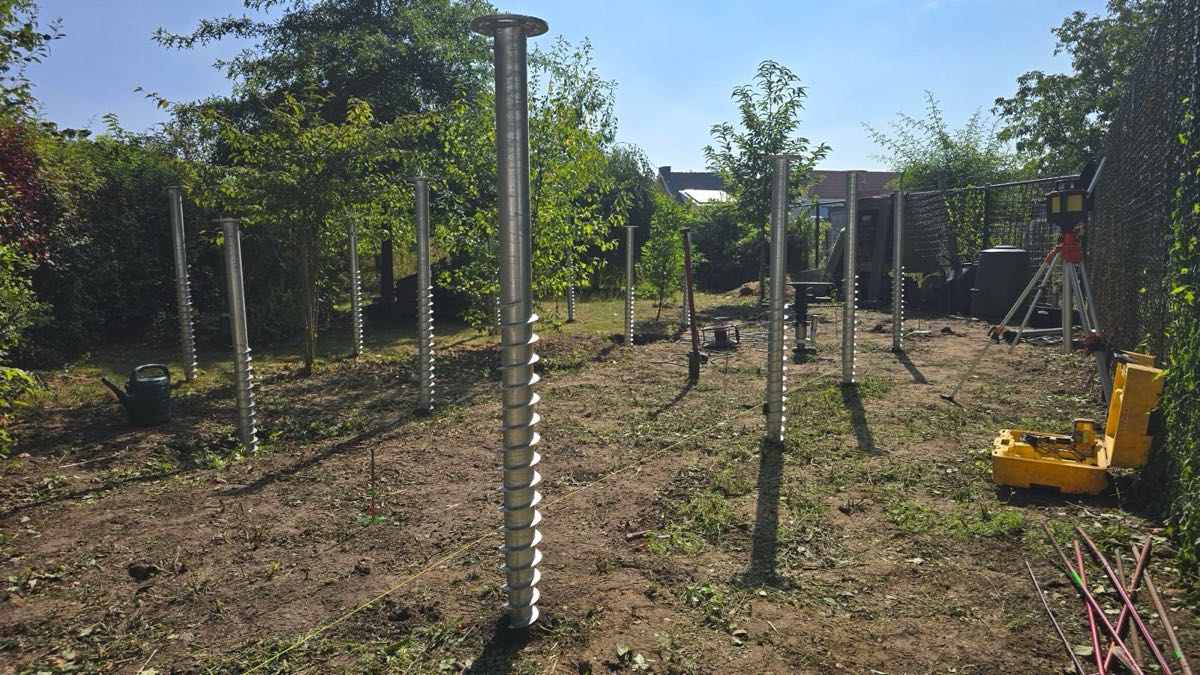
Frost depth is how deep the ground can freeze in a severe winter. In Belgium a frost-free foundation depth of about 0.6 to 0.8 m is used in practice.
On clay, drought counts as well as frost: the seasons act down to about 1.5 m. For heavier structures on clay we therefore go deeper than frost alone would require.
When designing a screw pile we do not count the top metre of soil for friction along the pile: that zone can dry out, freeze or has been backfilled.
Soiltek is a specialist contractor, not an engineering firm. We provide the manufacturer's product data and align the pile proposal with your structural engineer.
All pile types and their advantages.
For light and medium structures.
How many piles do you need?
All topics in one place.
For a shed that must not move, at least below frost depth. Our ground screws go 1.2 m or more for that in practice.
Not if it is deep enough. The thread then sits in ground that does not freeze.
Often, yes, because clay also moves with drought, down to about 1.5 m.
Send us the dimensions or a plan. We reply within two working days.
Request a quoteRead also: Foundations on clay, sand or peat: what does your soil mean? · Screw pile or concrete foundation: which fits your project? · Installation torque and capacity: how you know a screw pile will hold