Screw piles
All pile types and their advantages.

Knowledge · Steel
Steel piles rust, don't they? In the ground it happens much more slowly than you might think. With galvanising and the right wall thickness, a screw pile lasts for decades. This is how we work it out.
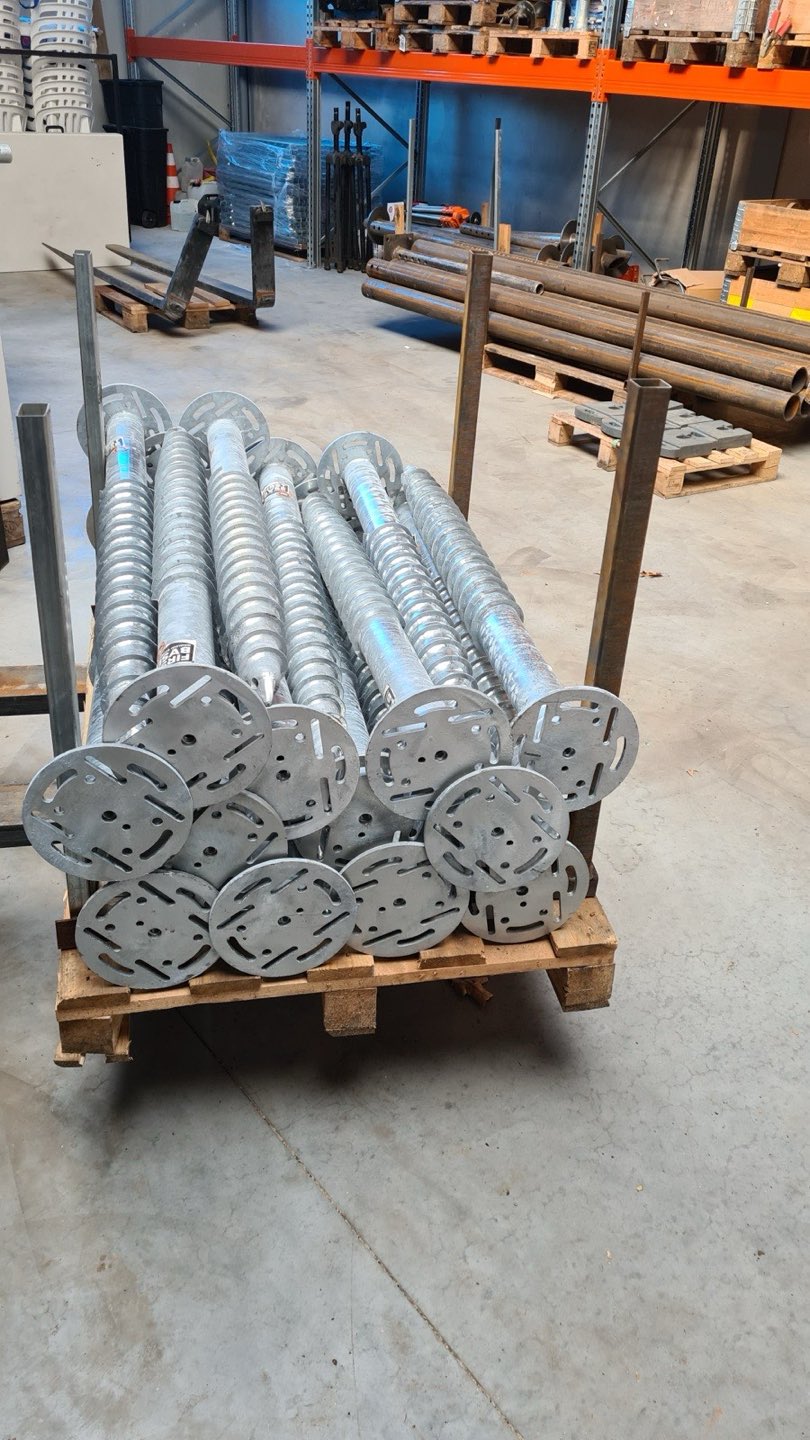
In undisturbed natural soil there is little oxygen, so corrosion is slow. The European standard for steel piles (EN 1993-5, table 4.1) gives a thickness loss for undisturbed natural soil (sand, loam, clay) of 0.6 mm per exposed face after 50 years, and 1.2 mm after 100 years.
The manufacturer of our screw piles guarantees the steel for up to 100 years. In ordinary ground we count on decades, comparable to traditional foundations.
Screw piles can be unscrewed and the steel is fully recyclable. No concrete is left in the ground.
Soiltek is a specialist contractor, not an engineering firm. We provide the manufacturer's product data and align the pile proposal with your structural engineer.
Sources: NBN EN 1993-5 (Eurocode 3, part 5: piling, table 4.1); ISO 1461; Paalupiste product information.
All pile types and their advantages.
For light and medium structures.
How many piles do you need?
All topics in one place.
In undisturbed ground corrosion is slow. With fluctuating groundwater or aggressive soil such as peat we choose a thicker wall or extra protection.
The steel is dipped in a bath of molten zinc, and the zinc layer protects it. The standard is ISO 1461.
The manufacturer of our screw piles guarantees the steel for up to 100 years.
Send us the dimensions or a plan. We reply within two working days.
Request a quoteRead also: Installation torque and capacity: how you know a screw pile will hold · Screw pile or concrete foundation: which fits your project? · A CPT sounding explained: how to read the ground