
History · October 2026
From lighthouse to garden office: the birth of the screw pile
Screw piles look like a modern invention, but the principle is almost 200 years old. It started with a blind man, a storm and a chance experiment.
A blind inventor in Belfast
Alexander Mitchell was born in Ireland in 1780 and gradually lost his sight between the ages of 6 and 21. He became a brickmaker and studied mechanics, mathematics and building in his spare time. What occupied him were the many shipwrecks off the coast: building lighthouses and beacons on sandbanks and mudflats seemed almost impossible, because an ordinary foundation sinks or washes away there.
According to the story, he found the solution by chance in the early 1830s. During an experiment with a screw-driven craft, the wind drove a screw into the ground, where it stuck fast. Mitchell tested the idea on a sandbank in Belfast Lough, and it worked. In 1833 he patented his "screw pile" in London. Its first use was mooring ships.
Lighthouses on screws
In 1838 the invention faced its big test: the Maplin Sands lighthouse, on an unstable sandbank at the mouth of the Thames. The foundation consisted of nine wrought-iron screw piles with a helix of about 1.2 m, turned by hand to more than 3 m into the seabed. The work took nine days. Mitchell visited his sites himself, even in bad weather, and checked the work by touch.
Success spread quickly. In the United States more than a hundred lighthouses were built on screw piles along the East Coast and the Gulf of Mexico between the 1850s and 1890s. Thomas Point Shoal Light in Chesapeake Bay still stands.
Seaside piers, Blankenberge included
From 1853 the British engineer Eugenius Birch used screw piles for the famous pleasure piers of the English coast, starting with Margate. Between 1862 and 1872 eighteen piers were built on screw piles, including Eastbourne and Brighton. Across the British Empire, bridges were founded on screw piles too, without a single cubic metre of concrete.
Closer to home, the first pier in Blankenberge, from 1895, also stood on screw piles. Today's pier is a later structure, but the principle then is the same one we screw into the ground today.
In 1848 Mitchell described his invention himself in the first technical paper on screw piles. He already wrote that the holding power depends on the area of the screw, the nature of the ground and the depth it reaches. That is still the basis of every calculation.
Forgotten, then back
Between 1900 and 1950 screw piles faded into the background as pile driving, bored piles and concrete piles took over. The comeback came with the hydraulic motor: with a powerful drive head on an excavator or tracked machine, installation is fast and precise, and the torque immediately tells how much the pile can carry. Better steel and hot-dip galvanising against corrosion followed.
At first the piles were mainly used as anchors against tension. Around 1980 they returned in the US as compression piles under buildings. Today they are a fully fledged foundation technique: fast, without excavation or curing time, vibration-free and fully removable.
And today?
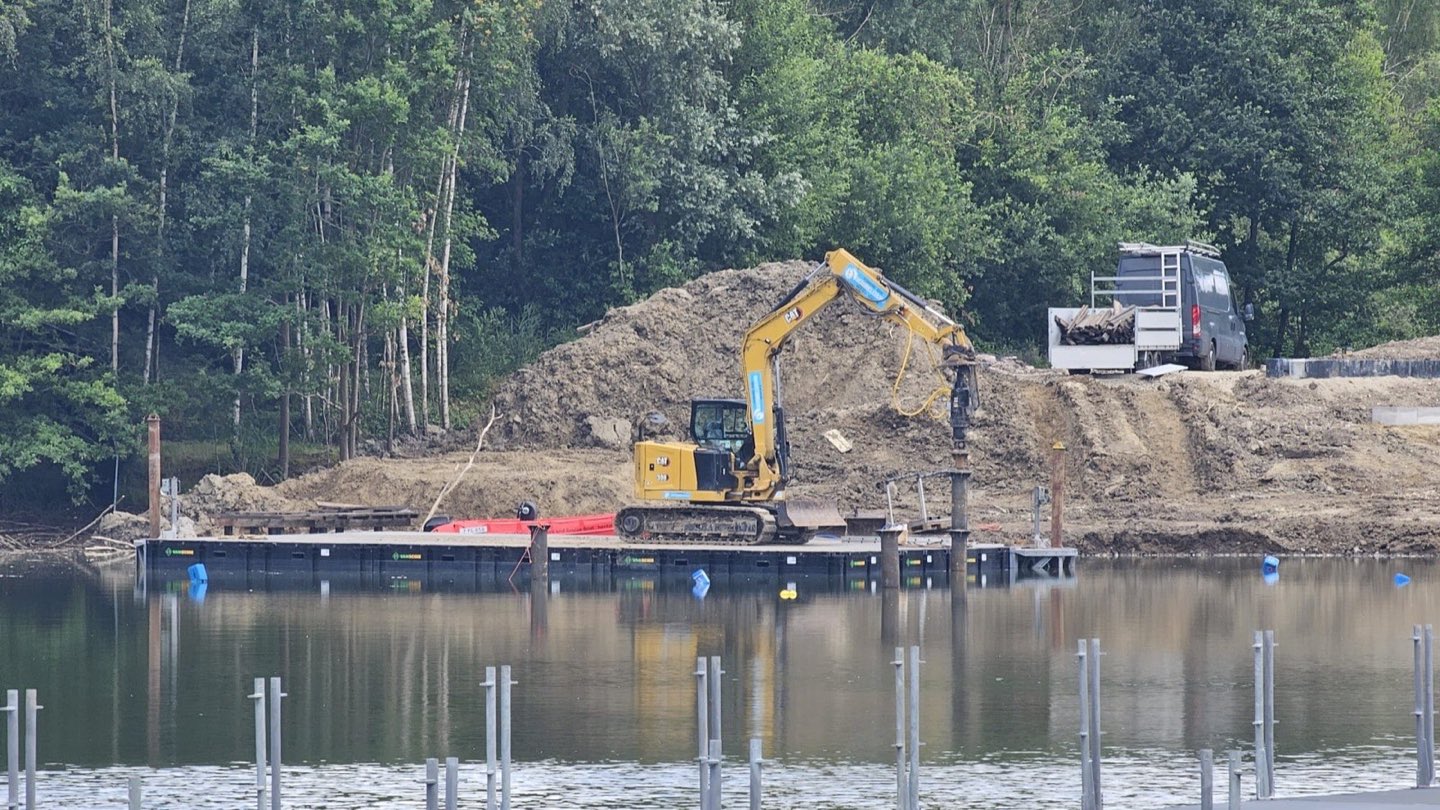
What Mitchell did with muscle power and a capstan, we do with hydraulic tracked machines and drive heads up to 132 kNm. Soiltek has installed more than 20,000 screw piles and ground screws: under homes, modular buildings, terraces, jetties, festival stages and battery parks. Even on the water, from a pontoon, as for Tomorrowland, just like the pioneers almost two centuries ago.
Sources: H.A. Perko, Helical Piles: A Practical Guide to Design and Installation, Wiley, 2009, chapter 1; A.J. Lutenegger, Historical development of iron screw-pile foundations: 1836–1900, 2003; A. Mitchell, On submarine foundations, particularly screw-pile and moorings, Civil Engineer and Architect's Journal, 1848.